


0
How to Make a Song Using Text Prompts with an AI Music Tool?

How to Make a Song Using Text Prompts with an AI Music Tool?
The year is 2025. Over 3.5 billion people around the globe are actively engaging with music streaming services, a testament to music's pervasive presence in our daily lives. Simultaneously, a quiet revolution is underway: the global generative AI in music market, valued at a substantial USD 569.7 million in 2024, is poised for an astonishing leap.
Projections indicate it will surge to USD 2,794.7 million by 2030, exhibiting a robust compound annual growth rate (CAGR) of 30.4% from 2024 to 2030. This isn't just about statistics; it's about a transformative shift, empowering anyone with an idea to become a music creator, regardless of their formal training or access to expensive studios.
Imagine: you have a powerful emotion, a vivid scene in your mind, or a captivating story you wish to translate into sound. Historically, this required years of dedicated musical study, mastering instruments, and often, significant financial investment. But what if a simple sentence, a few descriptive words, could magically conjure a complete song - melody, harmony, rhythm, and even lyrics?
This seemingly futuristic concept is no longer confined to science fiction; it is the tangible reality offered by Artificial Intelligence music tools. These innovations are not just enhancing music creation; they are democratizing it, making it accessible to millions who previously stood on the sidelines of musical expression.
What is the Revolution in Music Creation with AI?
For decades, music composition was largely viewed as an exclusive domain, requiring a unique blend of innate talent, rigorous training, and access to specialized equipment. The entry barriers were high. However, AI music tools are dismantling these barriers at an astonishing pace. These intelligent systems are meticulously trained on colossal datasets of existing musical pieces, enabling them to decipher intricate patterns, understand diverse structures, and even grasp the emotional nuances inherent in various genres.
This extensive learning allows AI to generate entirely novel compositions that possess a remarkable, almost human-like quality. The implications are vast, opening up a plethora of opportunities for budding artists, digital content creators, educators, and anyone simply seeking to infuse their daily lives with personalized soundscapes. The ability to transform textual prompts into fully formed musical pieces represents a paradigm shift, making music creation more intuitive and less intimidating than ever before.
How Can You Make a Song Using Text Prompts with an AI Music Tool?
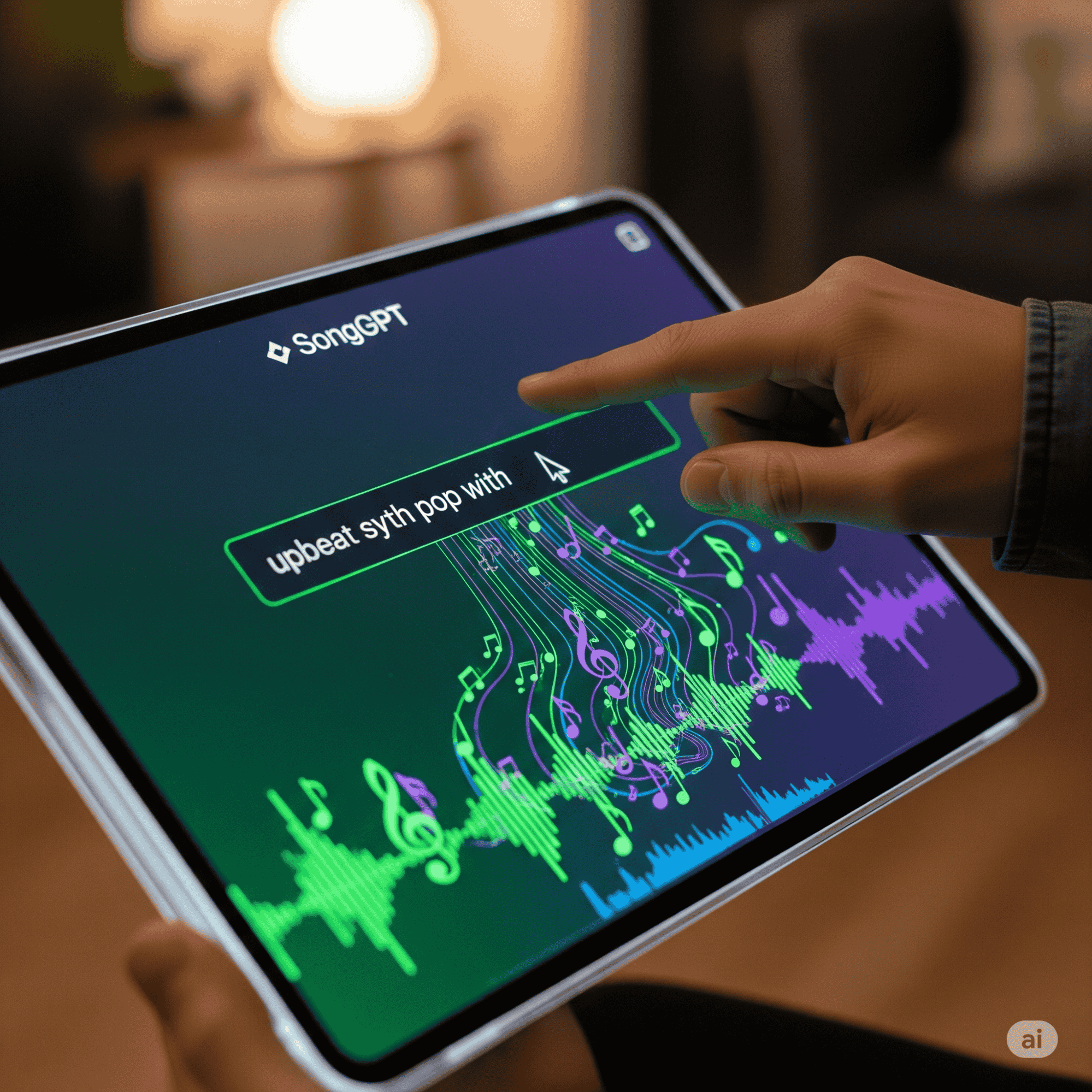
Embarking on this exciting journey of AI-powered music creation is far more straightforward than many might assume. Let's delve into the practical steps, using an exemplary tool like SongGPT, an innovative AI-powered music creation app designed to transform your textual ideas into professional-quality songs in mere seconds, completely eliminating the need for traditional musical skills.
Which AI Music Tool Should You Choose for Your Song?
The initial and crucial step on your musical odyssey is selecting the AI music generator that aligns best with your creative intentions. While the market offers a growing array of AI music tools, each boasting distinct features and functionalities, it's vital to consider the type of music you envision, your comfort level with technology, and your desired output.
For those seeking an intuitive platform capable of instant song creation from concise prompts, SongGPT emerges as an exceptional choice. It is thoughtfully designed to cater to a diverse user base, ranging from aspiring musicians to content creators and even those organizing special events, like wedding planners envisioning a unique, personalized song. The simplicity and efficiency of such tools make them invaluable for anyone starting their journey into AI music creation for beginners.
How Do You Craft the Perfect Text Prompt for Your AI Song?
This is where your imagination truly takes flight. The text prompt serves as your direct line of communication with the AI, the conduit through which you convey your precise musical vision. Think of it as painting with words, meticulously guiding the AI to grasp the genre, mood, instrumentation, and overall ambiance you desire for your composition.
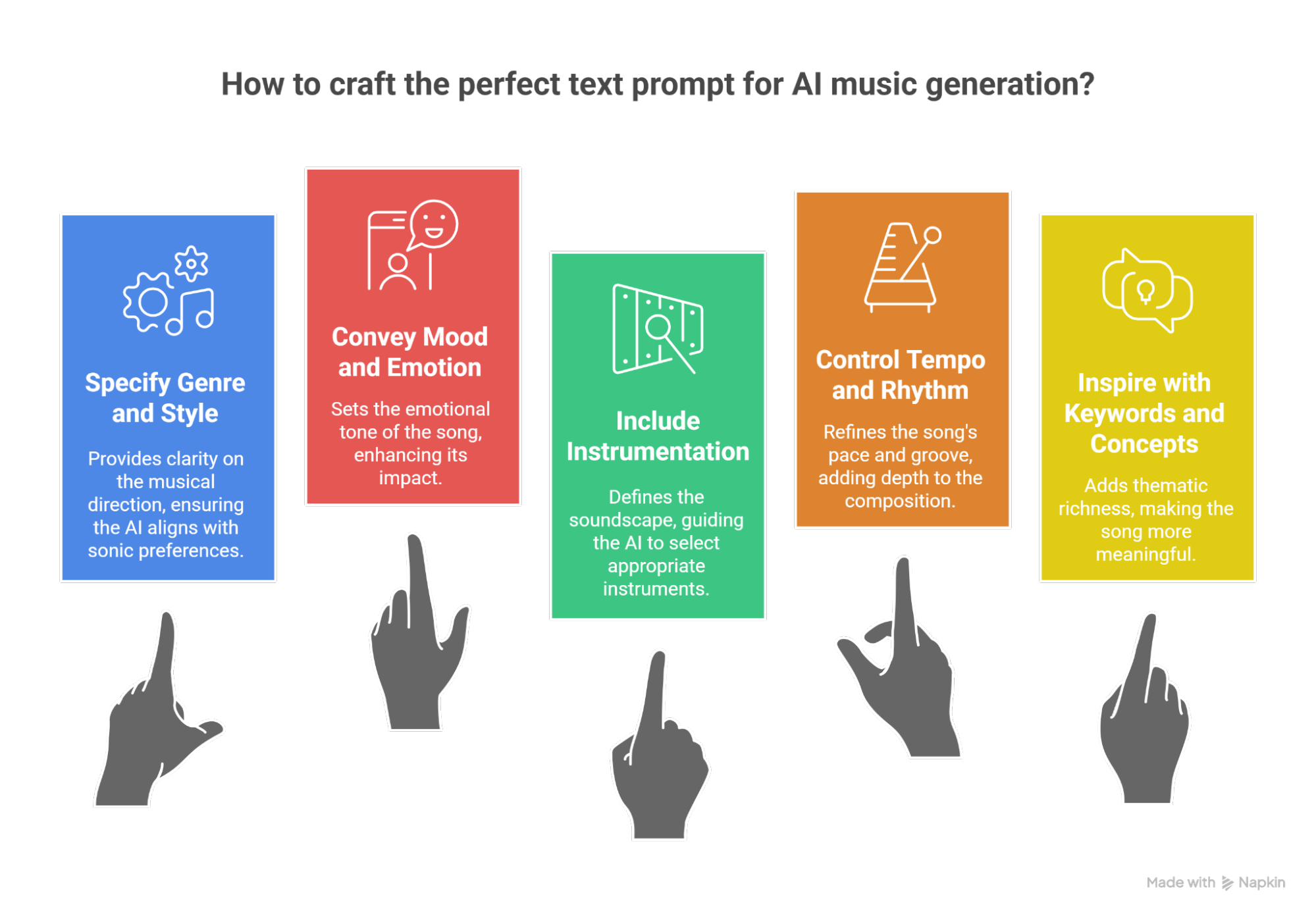
When crafting an effective prompt, consider incorporating these vital elements:
- What Genre and Style Should You Specify? Be incredibly specific! Instead of a generic "a song," elevate your request to "an upbeat pop song with a driving beat," "a melancholic piano ballad," "a high-energy electronic dance track for a club," or "a relaxing jazz piece perfect for a quiet evening." The more detailed your description, the more accurately the AI can align with your sonic preferences. SongGPT, for instance, excels at interpreting a vast spectrum of genres and even features a "Genre Blender" that allows for unique combinations like Hip-Hop with Classical or Country with Techno, fostering truly novel tracks.
- How Do You Convey Mood and Emotion to the AI? What emotional landscape do you wish to traverse? Do you want the song to evoke exhilaration, tranquility, mystery, pure joy, or perhaps deep introspection? Words like "energetic," "dreamy," "intense," "serene," "epic," or "haunting" can significantly influence the AI's output. Advanced AI programs are increasingly adept at processing lyrical themes, tempo variations, and harmonic structures to produce music that effectively conveys specific moods and feelings.
- What Instrumentation Should You Include? Picture the instruments performing your song. Do you envision the soaring crescendo of a violin, the resonant thump of a bassline, the gentle strumming of an acoustic guitar, or the futuristic sound of a powerful synth lead? Specify the instruments you'd like to feature. For example, "featuring a solo piano and a melancholic string quartet" or "with heavy bass, crisp drums, and shimmering synthesizers."
- Can You Control the Tempo and Rhythm? While not always strictly necessary for a basic prompt, adding details like "fast tempo," "slow, contemplative beat," or "upbeat, rhythmic groove" can further refine the AI's creation. Many AI tools provide user interfaces for setting these parameters, often allowing you to define a specific BPM (beats per minute) range, such as between 80 and 120 BPM.
- How Do Keywords and Concepts Inspire Your Song? If your song revolves around a particular theme or narrative, integrate keywords related to it. For example, "a song about overcoming personal challenges," "music ideal for a sunset road trip," or "background music suitable for a guided meditation video." SongGPT allows you to input simple yet powerful prompts like "Energetic dance track about celebrating freedom."
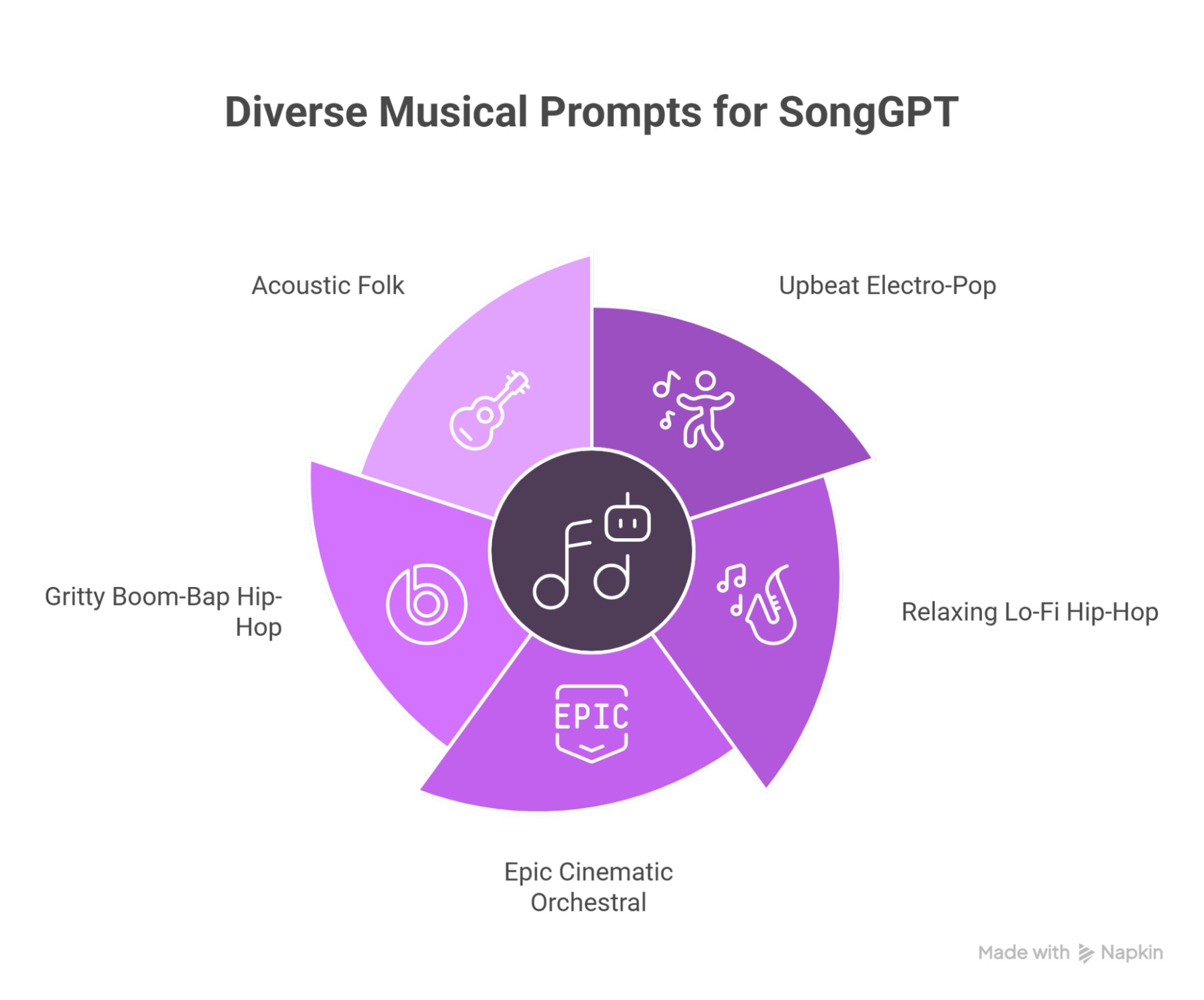
Effective Prompt Examples for SongGPT:
- "Upbeat electro-pop song about new beginnings, featuring bright, arpeggiated synths and a driving four-on-the-floor drum beat."
- "Relaxing lo-fi hip-hop instrumental for studying, with a smooth saxophone melody, gentle piano chords, and vinyl crackle."
- "Epic cinematic orchestral piece for a superhero origin story, with soaring strings, powerful brass fanfares, and thunderous percussion."
- "Gritty boom-bap hip-hop track about urban struggles and resilience, with a strong, distorted bassline and punchy, sampled drums."
- "Acoustic folk song about wanderlust and finding peace in nature, with intricate finger-picked guitar and a subtle, melancholic harmonica."
How Does the AI Generate Your Musical Masterpiece?
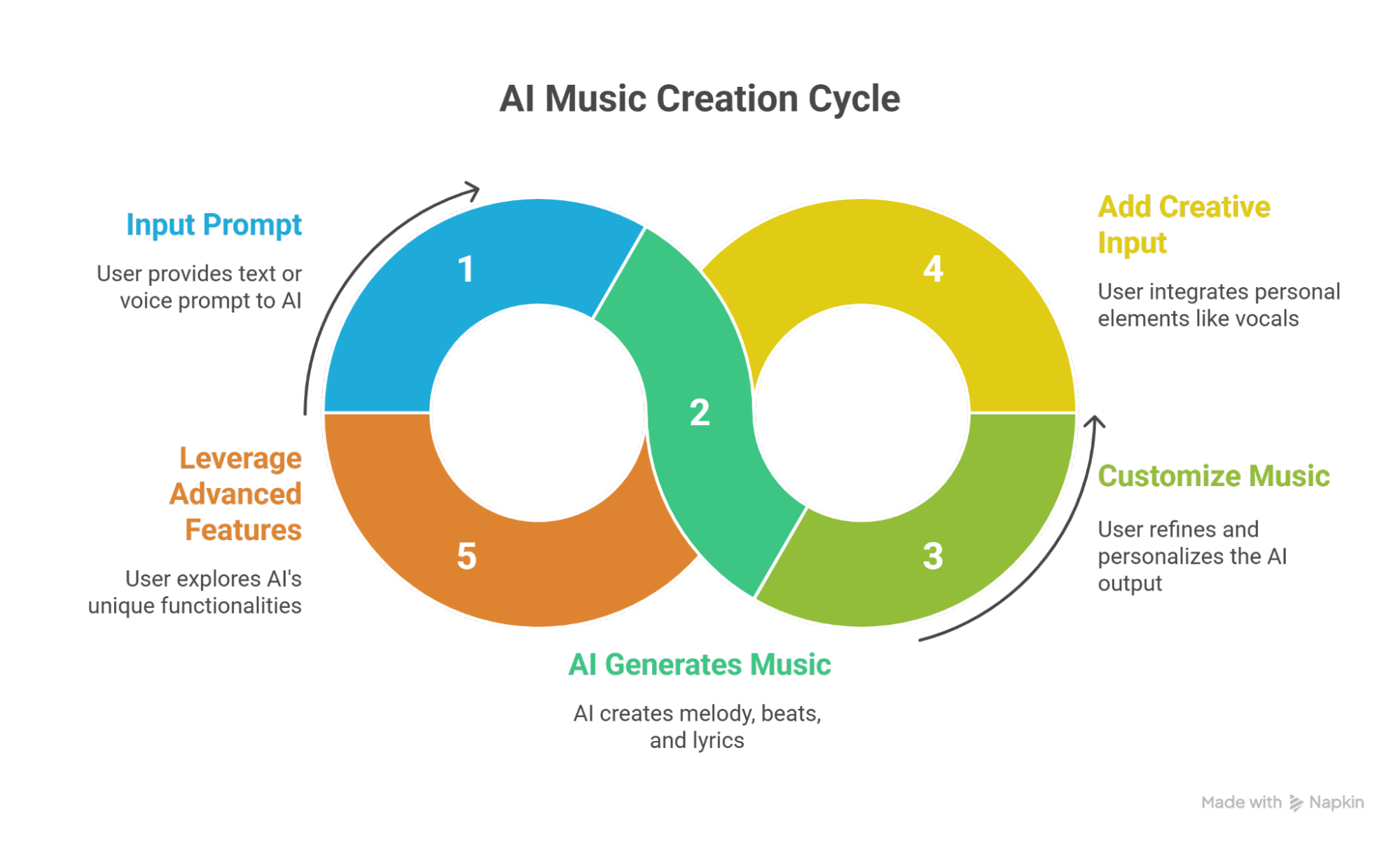
Once you have meticulously crafted your prompt, the next step is straightforward: simply input it into your chosen AI music tool. With SongGPT, you just type or even speak your idea, and the AI immediately springs into action. It diligently works to generate not only the melody and beats but also the full arrangement and, if requested, the lyrics, all within a matter of seconds. This remarkable speed and efficiency are among the most profound advantages of AI music composition from text commands.
How Can You Refine and Customize Your AI-Generated Song?
While AI is capable of generating impressively complex compositions, the true artistry often lies in the subsequent refinement stage. Most AI music tools, including SongGPT, provide a suite of options to customize and fine-tune the generated output. This vital step allows you to imbue the AI's creation with your unique human touch and artistic vision. Customization can involve:
- Adjusting Specific Elements: This might mean altering the tempo, changing the key to better suit a vocalist, or experimenting with different instrument sounds until you find the perfect timbre.
- Rearranging Song Sections: You have the flexibility to move verses, choruses, instrumental breaks, or bridges to establish the ideal structural flow for your song.
- Adding Your Own Creative Input: Many artists discover that AI-generated melodies serve as excellent starting points, which they then expand upon by recording their own vocals, adding live instrument parts, or incorporating unique sound design elements. This blending of AI generation with human creativity often results in emotionally resonant and deeply personalized tracks.
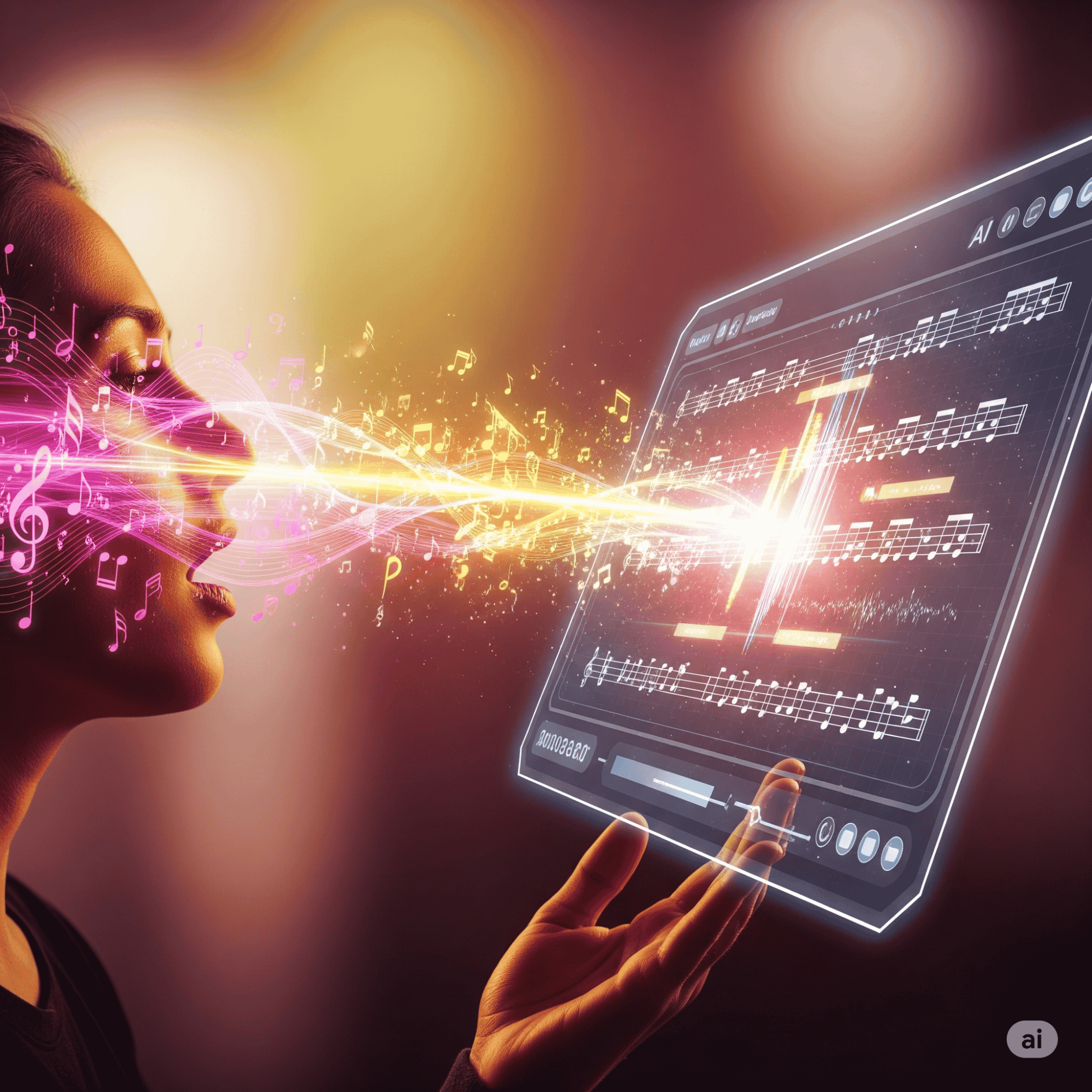
- Leveraging Advanced Features: SongGPT, for example, boasts a "Voice-to-Music" feature where you can speak your lyrical or melodic idea, and its AI voice generator transforms it into a full song, complete with AI-sung vocals. It also offers a captivating "Musify Anything" feature, allowing users to upload a photo, video, or even a document and receive a custom song inspired by its content.
It's crucial to remember that AI functions as a powerful collaborative partner, not a replacement for human ingenuity. It is a sophisticated tool designed to augment and ignite your musical expression, not diminish it.
How Do You Export and Share Your AI-Created Song?
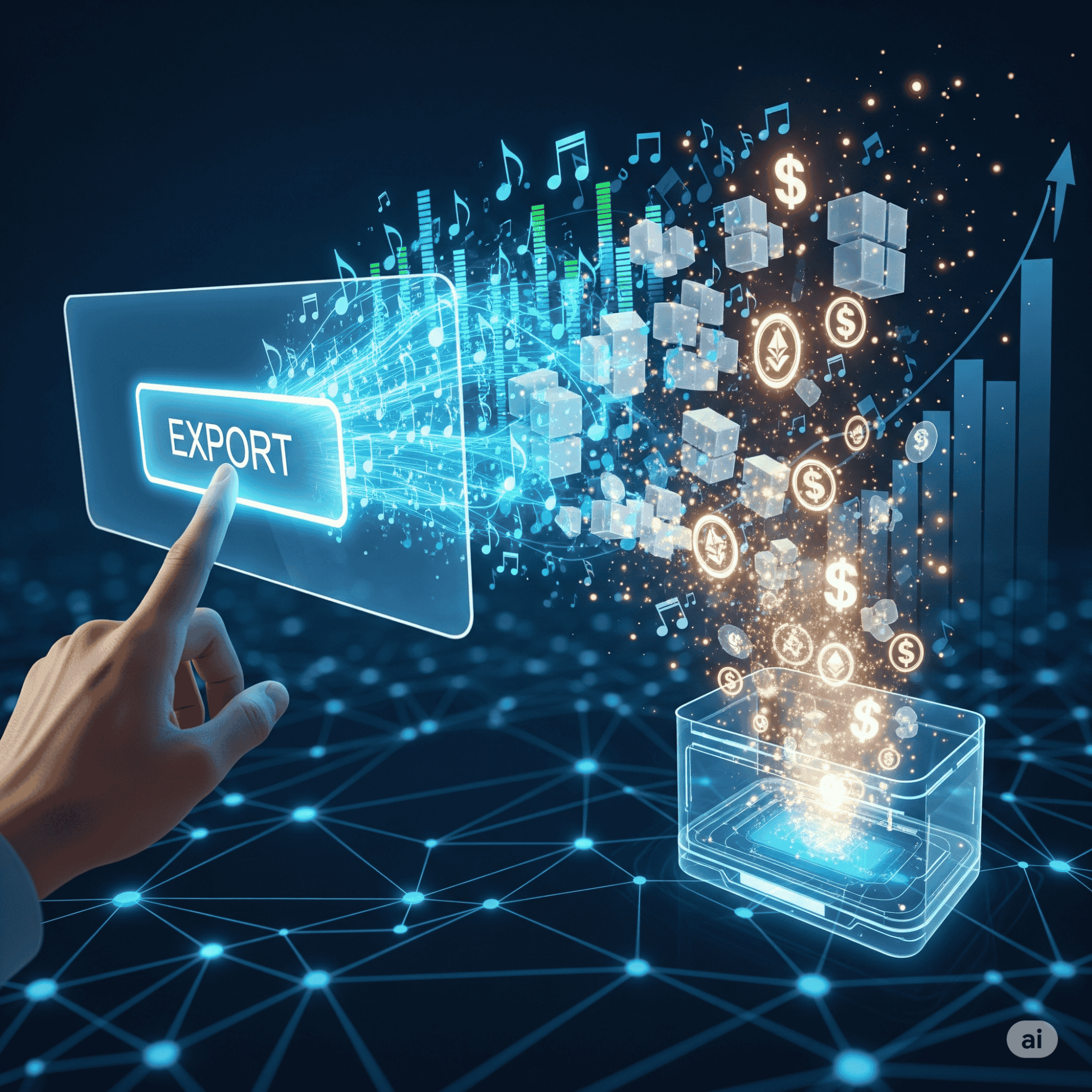
Once you are completely satisfied with your AI-generated song, the final step involves exporting it in a high-quality format suitable for various uses. SongGPT enables you to download studio-quality MP3s, making your creations ready for immediate streaming, sharing across social media platforms, or integrating into professional projects. This level of accessibility means that individuals without formal music education or access to expensive recording equipment can now produce polished, professional-quality compositions.
Furthermore, some platforms, including SongGPT, are exploring the exciting frontier of blockchain integration, offering users the ability to tokenize their songs on networks like Solana via pump.fun. This opens up entirely new avenues for creators to potentially monetize their music in a decentralized environment, seamlessly blending cutting-edge AI music technology with innovative blockchain solutions.
What is the Future Impact of AI in the Music Industry?
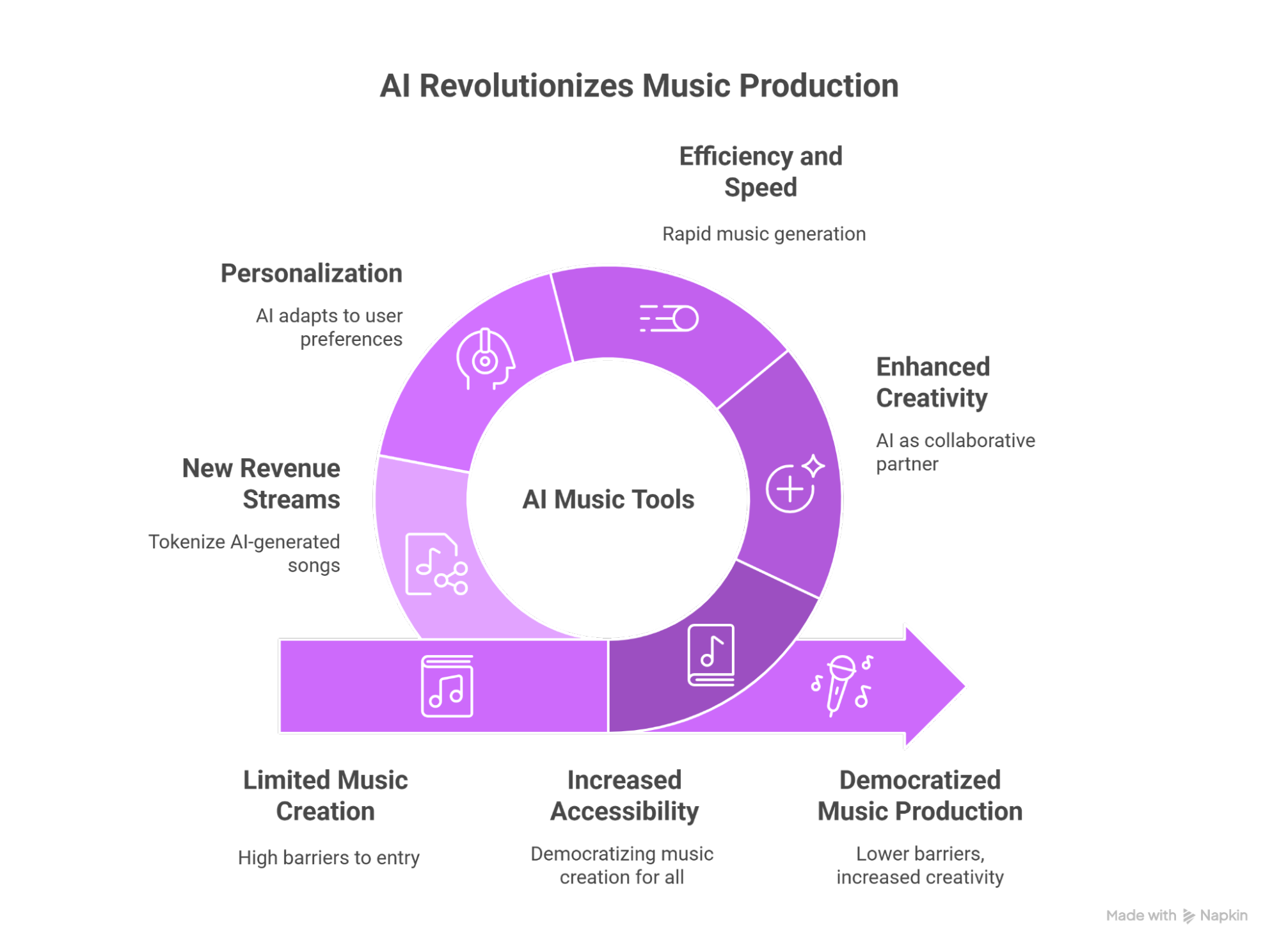
The integration of AI into music production is not merely a passing trend; it represents a profound shift with far-reaching implications for the entire industry. The global market for Generative Artificial Intelligence in Music was valued at US$642.8 million in 2024 and is forecast to surge to an impressive US$3 billion by 2030, growing at a strong CAGR of 29.5% from 2024 to 2030. This exponential growth is propelled by several key factors:
- Increased Accessibility: Is AI Democratizing Music Creation? Absolutely. AI music tools are fundamentally democratizing music creation. They empower aspiring musicians, hobbyists, and content creators to compose and produce music without needing extensive technical skills, deep music theory knowledge, or significant investments in costly equipment. This dramatically lowers the barriers to musical expression, fostering creativity among a much wider audience.
- Enhanced Creativity and Inspiration: Can AI Help Overcome Creative Blocks? Yes, AI can serve as an exceptional collaborative partner, offering endless suggestions, variations, and novel melodic or harmonic ideas that artists might not have conceived independently. By automating some of the more repetitive or technically challenging aspects of composition, AI frees up human artists to dedicate more time and energy to the truly creative and emotive dimensions of songwriting.
- Efficiency and Speed: How Fast Can AI Generate Music? Incredibly fast. AI can generate comprehensive musical pieces in mere seconds or minutes. This allows artists to rapidly prototype ideas, create background scores for videos or games, or produce custom music for diverse projects in a fraction of the time traditionally required. This efficiency is a game-changer for content creators on tight deadlines.
- Personalization: Will AI Create Personalized Music Experiences? Increasingly so. AI's capacity to analyze vast quantities of data, including user preferences, listening habits, and contextual information, will lead to increasingly personalized music experiences. Imagine AI-driven playlists that adapt to your real-time mood or create bespoke soundtracks for specific life moments.
- New Revenue Streams: Can AI Music Be Monetized? Definitely. Platforms like SongGPT are already innovating with features that allow users to tokenize their AI-generated songs on blockchain networks. This opens up novel possibilities for creators to potentially monetize their music through decentralized platforms and new ownership models, blending the best of AI music technology with the principles of Web3.
However, it is crucial to acknowledge the complex challenges that accompany this technological leap. Issues surrounding copyright and ownership of AI-generated content remain a particularly intricate legal landscape. The music industry has demonstrated a low tolerance for the unauthorized use of copyrighted material, as evidenced by recent high-profile lawsuits against AI music startups accused of training their models on copyrighted music without proper licensing. This highlights a critical need for careful consideration of data sources and the adherence to ethical practices in the ongoing development and deployment of AI music technologies.
Despite these complexities, the outlook for AI in music appears exceptionally bright. Industry experts largely anticipate that AI will continue to function as a powerful collaborative instrument, augmenting human imagination rather than rendering it obsolete. It is set to revolutionize personalization, streamline production workflows, and unlock boundless avenues for artists to push the very boundaries of musical creativity.
Frequently Asked Questions about AI Music Creation
What are the best practices for AI music prompts to get better results?
To achieve superior results, always be as specific as possible with your prompts. Include details about genre, mood, tempo, instrumentation, and any specific themes or lyrical concepts. Experiment with different descriptive adjectives and try iterating on your prompts to refine the output.
How can I learn to create songs with AI prompts if I'm a beginner?
Start with user-friendly platforms like SongGPT that are designed for ease of use. Begin with simple, clear prompts and gradually add more detail as you become comfortable. Explore the customization options offered by the tool to understand how changes in parameters affect the generated music. Many platforms also offer tutorials or prompt examples to guide beginners.
What are the key AI music production tips for text inputs?
Focus on clarity and conciseness in your prompts. Use strong action verbs and descriptive adjectives. Don't be afraid to experiment with abstract concepts if you're looking for unique or experimental sounds. Always preview and refine the generated tracks, treating the AI as a creative partner in an iterative process.